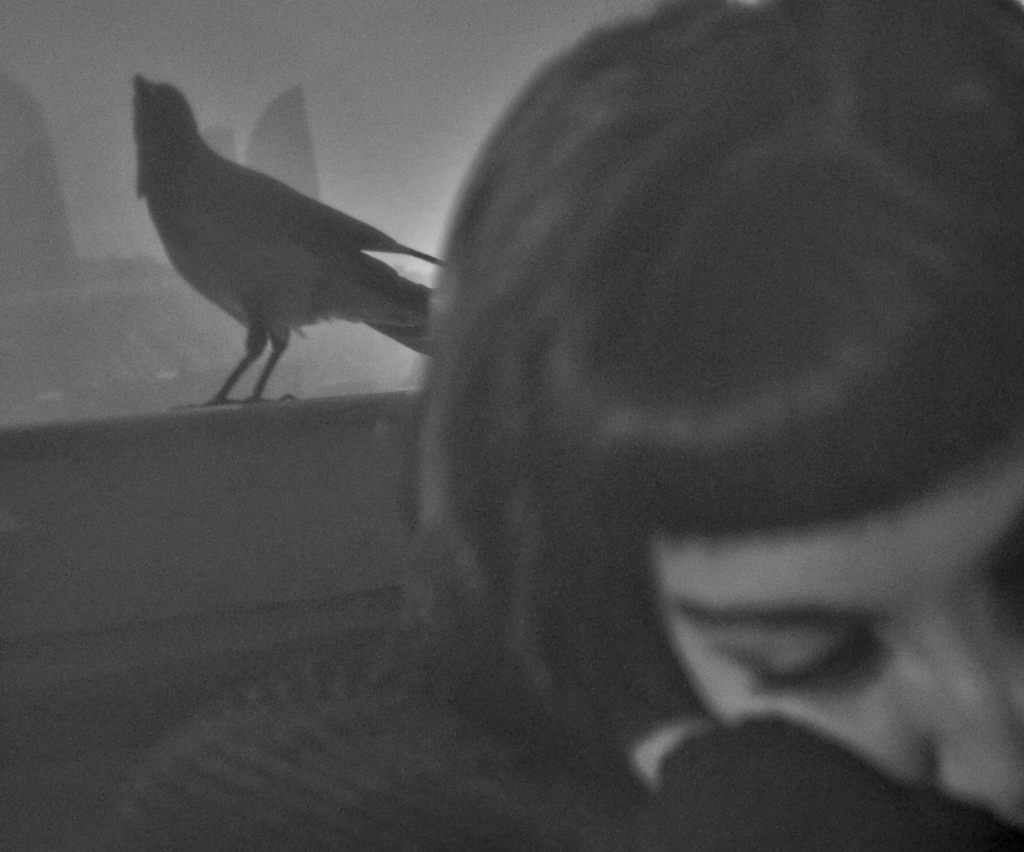
Noises on the roof, droppings on the car, shadows across the yard. The crows were nothing at first, but after a few weeks, they were everywhere. There were crows in so many places, it was a wonder she noticed that one stood out from the rest.
Angie began reading posts on the neighborhood app from people on her street. “How do I get rid of the crows?” “Anyone else having problems with crows?”
Neighbors had also begun congregating on the street. At first, it was only on trash night, but soon they were outside comparing notes at the same time each evening.
“I know how to solve it: with a shotgun,” said Jim, one of the neighbors. “Won’t that scare the golfers?” asked another neighbor. “The birds are tied to the chemtrails,” said a third neighbor. “Chemtrails aren’t real,” Jim said.
What began as novelty had quickly become nuisance. Angie could hear the noise of their legs swaggering across the roof tiles through the ceiling. She saw them in the trees across the street, congregating, and heard their caws overhead when she put her wet laundry outside to dry. Every day, she had to hose off her car, which had become a black canvas for white bird excrement.
What began as a novelty had quickly
become nuisance
Angie listened to the nightly conversations, trying not to get involved, resigned to let the crow situation play out as a bystander, but the more she noticed the one crow that seemed different from the rest, the more she was drawn in. She noticed how it cocked its head and appeared to listen to conversation. One day when she opened the sliding door, it flew across the sky and dropped an acorn onto her head at the precise moment she walked onto the patio. The crow looked familiar and seemed somehow more expressive than the other crows. She felt like it was trying to get her attention.
Soon, Angie noticed that whatever she did, the distinctive crow was standing in the distance watching. Whether in her back yard, in the driveway, on the street: it followed her. She felt sure it was the same crow, and even more confident it was listening and watching. She challenged that certainty back and forth in her mind, laying out questions and answering them. Could it be different crows with the same mannerisms? Maybe it wasn’t listening at all? Maybe it was randomly waiting for other crows to fly by or using its small crow brain to figure out a way to pick up a candy wrapper from the street? Yet, the one special crow didn’t seem random, and didn’t seem to relate to the rest of the flock. It stared at her a lot, and it left and came back by itself without the other crows. It concentrated, it cawed in a distinct pattern, and it came closer to her than any of the other crows.
As time went on, she stopped questioning whether the crow was listening and watching. She knew it was the same crow, and she knew it was listening and watching.
It was listening and watching
She started making eye contact and trying to distinguish characteristics, so she could pick it out from the group of crows. She studied its size and measured it with her eyes: it’s one half the width of the clay flowerpot that holds the pansies, and the same length as the trowel. Angie looked for patterns in its habits, like the time of day it arrived and whether it landed in the same spot in the driveway.
One day, she was on the hammock in the back yard reading a book and she noticed it land on the lawn several feet away and lock into a stare with her. The eyes looked so familiar. She couldn’t place it, but she was sure she’d seen those eyes before. It finally dawned on her: the eyes belonged to her father.
She thought of a time she had been kicked off the volleyball team at school and how her father had looked at her for a long time as he held the letter from the coach in his hands. He had stared her down with his brown eyes, waiting for an explanation. Decades later, Angie was recently reminded of that stare as her father went in and out of consciousness in his final hours. Sometimes it seemed as if he had passed, then warm breath escaped his nose, signaling life when nothing else did. She recalled in those final hours, how his eyes opened widely and with intent. They shifted and appeared engaged, but then they’d go into a dead stare. Angie couldn’t tell if his eye patterns were an uncontrollable physical response, or if he was studying her, trying to remember every detail of his daughter to pack in the knapsack of experiences he was taking into the afterlife with him.
A couple months into the crow invasion, the crows weren’t letting up, and neighbors continued to come outside to compare notes. Angie had been waiting for an opportunity to share the news that one of the crows was her father. One night she saw several neighbors gathering and went outside to join the group. They had taken turns talking about the noise on their roofs and droppings on their clean cars, and she finally found a calculated moment to nonchalantly slip in her question.
One of the crows was her father
“Does anyone ever get the feeling some of these crows know us?”
Jim leaned against his black trash bin and said, “Huh. I can’t say as I DO think these BIRDS know us.” He exaggerated the words “do” and “birds.”
Angie was relieved when a neighbor rescued her. “Crows are very smart, they have the intelligence of chimpanzees, it’s possible they know us.” But the relief was short-lived. Jim pointed at a group of crows in the street cawing back and forth, pecking their beaks at a crack in the street. “We got a gaggle of geniuses right here on the road waiting to get hit by a car,” said Jim. “Isaac Newton, is that you?” he asked a crow.
When Angie woke up the next day, her special crow was standing outside the glass patio door, waiting for her to come down for breakfast. She knew it was the same crow, because she had begun keeping notes in a small notebook. “Dark gray beak with one-inch white line at the bottom of the left side. Top feathers turned slightly up. Favors the back side of the roof. Leaves between breakfast and lunch, returns between 1 and 2 p.m.”
Once she had proven to herself that it was the same crow visiting her every day, she looked for clues to confirm her next theory: the crow was her father.
Angie paid attention to whether the crow was on the patio when she was listening to baseball in the evenings. She set up experiments where she did the things that had displeased her father when she was growing up, like wearing skirts that were too short and cursing excessively. She combined several elements to test her theory. She wore a very short skirt and a crop top one day, then loudly cursed when her father’s least favorite baseball player struck out, all while watching the crow, noting any signs of distress. She recorded her findings in the notebook labeled “Dad.” When the crow flew onto the neighbor’s roof after one particularly loud tirade of cursing, (Angie had become authentically enraged when the baseball team lost in extra innings after the pitcher committed a balk) Angie said to the crow, “Knock it off, Dad!” and it flew away.
She combined several elements to test her theory
As time passed, the signs that the crow was communicating with her were becoming too numerous to record in her notebook. The pages had been filled with examples like how the crow gathered with a group of crows on Sunday afternoons–the same day and time her father’s poker group had convened for twenty years. She wrote about how the crow enjoyed eating her father’s favorite foods–peanuts and toast. Another example she noted was how the crow listened to baseball games in the afternoon and flew back and forth when innings dragged on too long.
Each night when the neighbors gathered, Angie talked about the things she and her crow father had done that day: read a book together, mowed the lawn, drank a beer. Gradually, the neighbors talked less about the crows on their roofs and changed the subject so Angie would not embarrass herself. “My granddaughter is starting sixth grade next week,” her neighbor Candace said as Angie had been describing how her dad-crow had eaten a Fig Newton for breakfast.
By this point, anytime Angie talked about her father, the neighbors assumed she was talking about the crow. In Angie’s mind, the crow was her father as much as the man who had died was. Her father had simply changed form. All the things she never said to him when he was alive were being discussed every day on the patio with the bird. She talked about how she had felt in third grade when he had forgotten to pick her up from school. She confessed that she hadn’t really broken her leg tripping over a median in the Wal-Mart parking lot her junior year of high school. She’d been drunk with friends and didn’t even know how she’d broken it. She also said something to the crow she’d never been able to say when he was a person: “Dad, I love you.”
The crow was her father as much as the man who died was
The neighbors began to put their trash out in the morning to avoid Angie. They discussed how disturbing it was that she thought one of the crows was her father. They wondered whether they should do something about it, but nobody knew what to do. They didn’t know if she had any family left after her father died, and they didn’t know any of her coworkers or friends. They decided there was nothing they could do.
One day when Angie was trimming the shrubs in her backyard, the special crow landed a few feet from the shrubs, looked straight at her and talked.
“Hello.”
Angie lit up with excitement and relief. She knew the neighbors didn’t believe the crow was her father, and she was beginning to wonder herself if something could be wrong with her, but now she knew that everything she believed about the crow was correct. She finally had evidence. She put the hedge clippers on the ground, and began to cry to the crow, “Daddy, Daddy, it’s me, your Angie,” but as she got close to the crow, it flew away.
Angie wanted to put a stop to the neighborhood whispers and disapproving looks, and now she knew how she could do it. She could prove she was not crazy by getting the crow to talk. If she could get Crow Dad to say something in front of the neighbors, they’d see she was normal. One night, when she saw her father out in the street gathering small sticks with his beak, she knocked on Jim’s door and asked him to come outside and bring Candace with him.
When the three neighbors gathered together, Angie pointed to the crow in the street, broke a peanut shell in two, took out the nut and set it near the crow. “Watch this.” Her crow dad ate the peanut, cocked its head forward and said, clear as day, “Thank you.”
Watch this
Angie began to tear up, and Jim and Candace looked at one another in amazement. They had both watched the crow respond on queue and heard it talk! And, they had seen a woman full of love, and a lifetime of yearning, being fulfilled in one of the most inexplicable, amazing ways.
But their amazement reached new heights with what happened next. When the crow turned to leave, it said “Angie.” It was clear and distinct, with the first syllable drawn out: “Annn-gie, Annn-gie.”
Angie went to her knees with joy, and stayed there beside the trash bins, pointing to the sky with her fingers intertwined into a prayer posture before looking to the black bird, nodding and creating a heart shape with her hands.
Jim and Candace began telling the rest of the neighbors what had happened. “Ok, I admit it, I admit it, I thought she had lost it, but the damn bird is her dad,” Jim said. “I heard it with my own ears. The bird looked at her and said her name.”
I heard it with my own ears
Not long after, leaves were falling from trees, evenings were getting cold and Fred had begun hearing Great Horned Owls at night performing their rhythmic hoots back and forth. Fred stood by his trash can one morning and said he’d seen the owls and the crows at dusk going after each other. “I wouldn’t be surprised if the owls don’t stay long, or maybe the crows will move on.”
Angie listened to Fred and said, “The regular crows might leave, but Dad will stay.”
Fred looked at Angie, the same age as his own daughter, with a patronizing smile. “Whatever or whoever that old crow is, it’s still a crow, and it belongs to nature, and when the rest of the crows leave, it will leave with them.”
Angie walked away, and the crow flew behind her and settled onto her roof.
As fall moved forward with the days shortening and the owls appearing earlier every evening, the number of crows went down each day. Angie was confident her dad would not leave her, because he didn’t belong to nature, he belonged to her. Nevertheless, each morning, she nervously counted the crows in the street from her bedroom window. She woke up hoping the number would be larger and not smaller, yet every morning there were fewer and fewer crows, until one morning her crow dad had disappeared, too.
She sat in the hammock in her winter coat, singing songs her father used to enjoy. She sang Kenny Rogers’ Coward of the County. She sang Blue Bayou, King of the Road and Paper Roses—anything she could remember coming from the cassette tapes in her father’s used Buick.
She sang Kenny Rogers’ Coward of the County
Day after day was cold and dreary, and the Great Horned Owls, too, shifted their patterns with the call of nature, moving out of the neighborhood. The winter weather meant conversation at the trash bins was reduced to quick waves followed by dashes back into the house, until the day a new neighbor appeared next to a bin.
The house at 3323 Rock Ridge Way had been vacant for the better part of the year, and the dilapidated home had finally sold in the fall to a woman named Jan. It was not the first house Jan had fixed up and turned a profit on, and despite its decrepit state, the bones of the place were good, and Jan said her plans to renovate it could begin as soon as she was done getting rid of the trash that had been left in the back yard. The previous owners weren’t hoarders, but they were close to it, Jan said. “Cracked resin chairs all over the yard, a picnic table with rotten boards, broken cabinet doors, stacks of receipts, books with no covers—I have my work cut out for me on this one,” she said. “I’ve seen it all, at least I thought I had. . .” Jan trailed off, then picked her thought back up. “This house did come with one thing I can’t say as I have ever seen.”
Jan stopped talking
Jan stopped talking, partly for dramatic effect and partly because Angie had begun pulling her recycling bin around the corner of her house and was approaching. Jan took a breath before telling the group of curious neighbors what she’d seen in her new house that she’d never seen before. Angie came closer, dragging the big blue bin on its wheels and waved to the group from four or five feet away as Jan said, “The people who owned the house, the Mateens, Skip and Maddie, they used to feed all the birds that came around. Not just bird food, but pieces of moldy bread and peanuts and table scraps. They even had a crow they let come into the house, and they taught it to talk.”
Like two cars backing out of parking spaces at the same time, Jan and Angie were about to crash, and everyone saw the crash that was on the verge of happening except for the two parties involved.
“Hello, Jan,” said Angie. “How is it going over at 3323?”
“It’s a lot of work. I was just telling the group what a mess those Mateens’ were. Trash everywhere, and a crazy bird operation that’s led to rodents and a hell of a lot of clean up. They even taught a damn crow to talk.”
Fred quickly dove in to change the subject by pointing to a cat on the hillside, but the conversation unfolded too fast, and Jan said it.
“There was a crow that was coming to the door and trying to get in. It startled me at first. It said ‘hello,’ and ‘thank you’ one day, and I thought someone was in the house. Then I heard it say, ‘Polly wanna cracker.’ The Mateens’ must have been quite the classic rock fans. Last month, I was cleaning up the house jamming to the Rolling Stones, and I heard the bird say, ‘Angie,’ when the song ‘Angie’ came on.” Jan laughed and slapped her stomach. “Once the bird realized I wasn’t gonna give it a slice of toast every morning like the Mateens’ did, it took off. It’s probably begging at somebody else’s door.”
Angie’s face had been slowly losing its shape
Angie’s face had been slowly losing shape while she listened to Jan talk. By the time Jan had finished the story, Angie’s face was an unrecognizable, grotesque distortion of the woman the neighbors knew.
When Jan stopped talking, Angie let out a noise that sounded like an animal crying. She left the recycling bin at the curb and walked back toward her dark house.


Leave a Reply